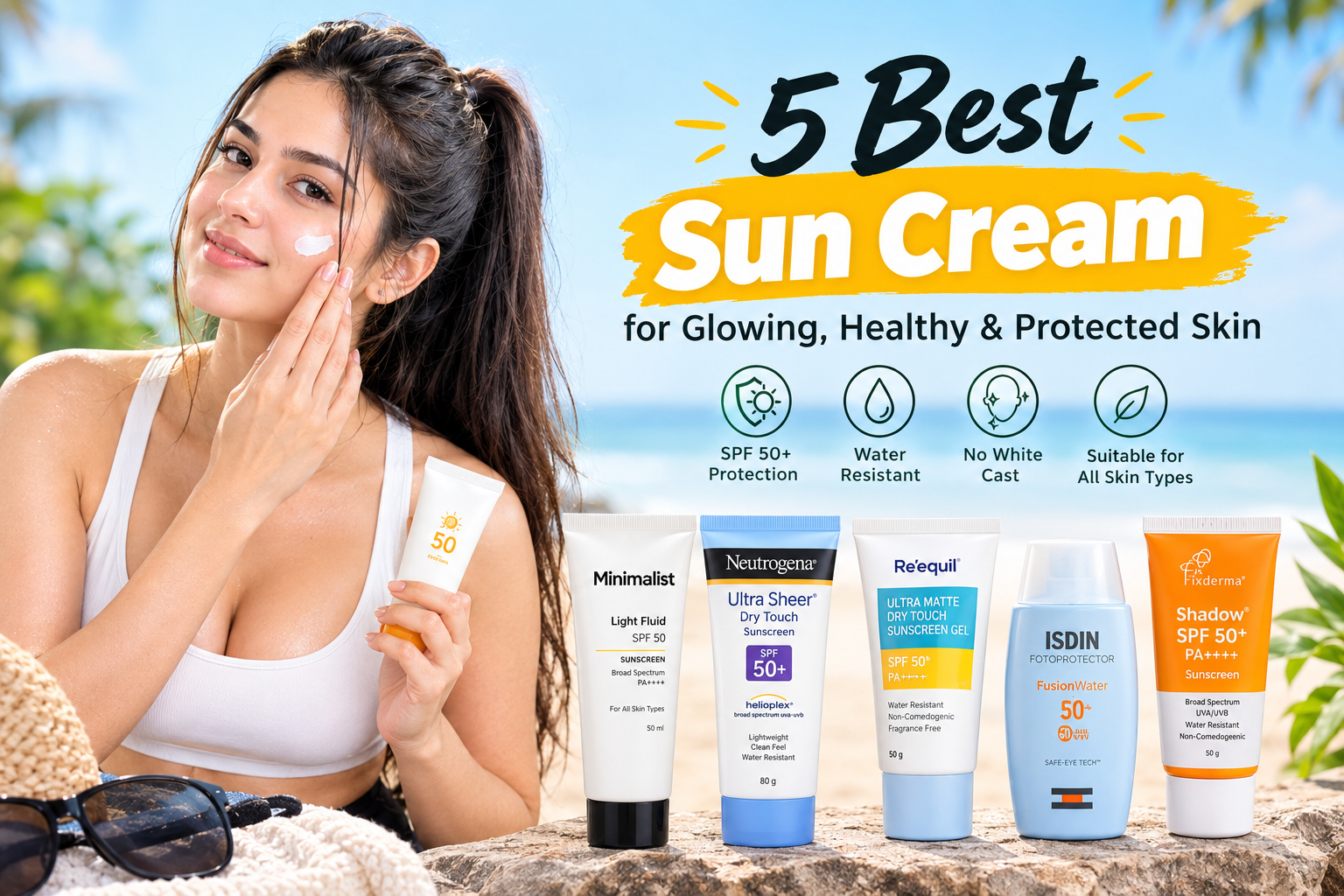
5 best sun cream options can make choosing daily sun protection much easier, especially when there are so many SPF products available. A good sun cream should provide adequate UV protection while also feeling comfortable enough to use every day.
Dermatologists recommend choosing a sunscreen that provides broad-spectrum protection, SPF 30 or higher, and water resistance. Broad-spectrum protection means the product helps protect against both UVA and UVB rays.
5 Best Sun Cream for Glowing, Healthy & Protected Skin
In this guide, we look at five popular sun creams and sunscreens that can be considered for different skin types and preferences. We also explain what SPF means, how much sunscreen to use, when to reapply it, and how to choose the right product for your skin.
Focus Keyword: 5 best sun cream
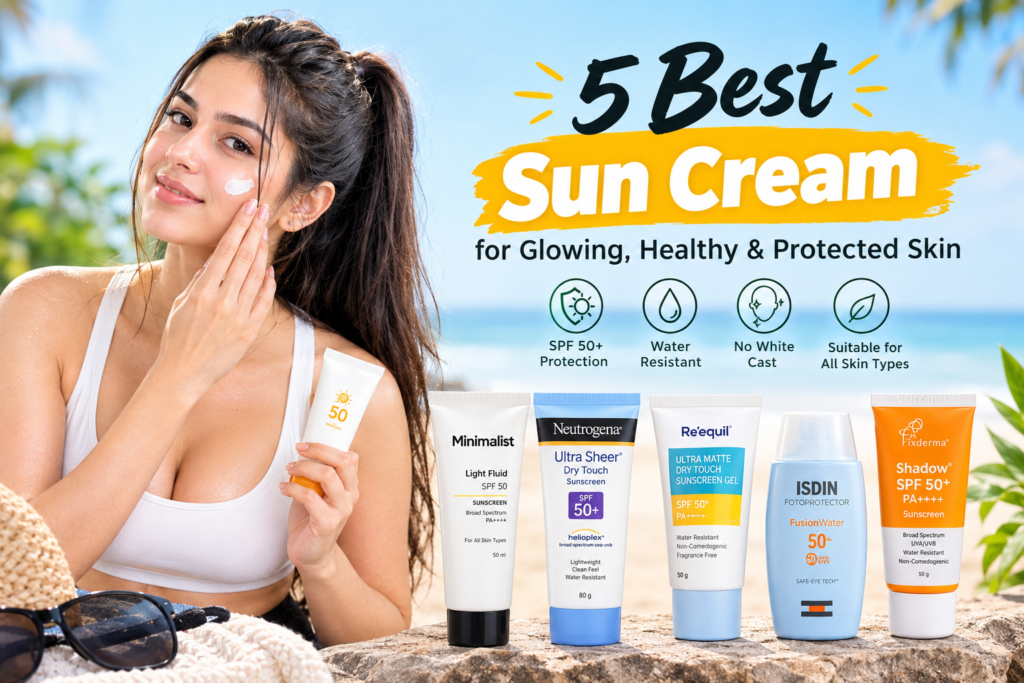
Table of Contents
- What Is Sun Cream?
- Why Is Sun Cream Important?
- 5 Best Sun Cream Options
- How to Choose the Best Sun Cream
- Sun Cream for Different Skin Types
- How to Apply Sun Cream Correctly
- Frequently Asked Questions
- Conclusion
What Is Sun Cream?
Sun cream is a topical product designed to protect your skin from ultraviolet radiation.
You may see products called sunscreen, sun cream, sunblock, sunscreen gel, sunscreen lotion, or sunscreen fluid. The texture can be different, but the important thing is the protection offered by the product.
The American Academy of Dermatology recommends looking for SPF 30 or higher, broad-spectrum protection, and water resistance.
Using sun protection regularly can help reduce sunburn and UV-related skin damage and can also help reduce premature signs of skin aging.
Why Is Sun Cream Important?
Daily sun exposure can affect your skin even when you are not spending the entire day at the beach.
UV exposure can contribute to:
- Sunburn
- Uneven skin tone
- Dark spots
- Premature skin aging
- Wrinkles
- Loss of skin elasticity
- Long-term UV-related skin damage
The American Academy of Dermatology recommends combining sunscreen with other sun-protection habits such as seeking shade and wearing protective clothing.
This is why choosing a sunscreen that you enjoy using regularly can be more useful than buying a product that feels uncomfortable and then skipping it.
5 Best Sun Cream Options
1. Minimalist Light Fluid SPF 50 Sunscreen
Minimalist Light Fluid SPF 50 is a lightweight sunscreen designed for everyday use.
The manufacturer’s current product information describes it as broad-spectrum SPF 50 with PA++++, water resistant, non-comedogenic, fragrance-free, and suitable for all skin types. It uses filters including Tinosorb M, Uvinul A Plus, and OMC.
Key Features
- SPF 50
- PA++++
- Broad-spectrum protection
- Water resistant
- Lightweight fluid texture
- Non-comedogenic
- No white cast according to the manufacturer
- Available in multiple sizes
Its lightweight texture may make it convenient for people who dislike heavy sunscreen on the face.
Best for: People looking for a lightweight everyday facial sunscreen.
2. Neutrogena Ultra Sheer Dry Touch Sunscreen SPF 50+
Neutrogena Ultra Sheer Dry Touch Sunscreen SPF 50+ is a well-known option in India.
The official Neutrogena India website lists SPF 50+ and PA++++, along with water and sweat resistance and a dry-touch finish. The product is available in 30g and 80g packs on the current product page.
Key Features
- SPF 50+
- PA++++
- Water and sweat resistant
- Dry-touch finish
- Lightweight texture
- Designed for face and body
- Available in different pack sizes
This can be an option for people who prefer a sunscreen with a dry-touch finish rather than a very dewy appearance.
Best for: People who prefer a dry-touch sunscreen for daily use.
3. Re’equil Ultra Matte Dry Touch Sunscreen Gel SPF 50
Re’equil Ultra Matte Dry Touch Sunscreen Gel SPF 50 is another popular Indian sunscreen option.
The manufacturer’s current listing describes it as water resistant, non-comedogenic, and suitable for all skin types. Its gel formulation is designed to provide an ultra-matte finish.
Key Features
- SPF 50
- Ultra-matte finish
- Water resistant
- Non-comedogenic
- Gel texture
- Designed for daily use
A matte sunscreen can be particularly appealing if you dislike a greasy appearance after applying sunscreen.
Best for: People who prefer a matte or less-shiny finish.
4. ISDIN Fotoprotector Fusion Water SPF 50
ISDIN Fotoprotector Fusion Water is a lightweight facial sunscreen designed for daily UV protection.
The current ISDIN product page describes Fusion Water as an SPF 50 facial sunscreen providing protection against UVB and UVA rays. The tinted Magic Light version also provides light coverage and helps even the appearance of skin tone.
Key Features
- SPF 50
- UVA and UVB protection
- Lightweight facial formula
- Tinted version available
- Designed for daily use
The tinted version can be useful for people who want a little complexion coverage along with sun protection.
Best for: People looking for a lightweight facial sunscreen, including a tinted option.
5. Fixderma Shadow SPF 50 Sunscreen
Fixderma offers several SPF 50 sunscreen formats, including gel, fluid, tinted, spray, serum, and stick formulations.
Its Shadow SPF 50 Roll-On is described by the manufacturer as water resistant, oil free, lightweight, non-comedogenic, and broad-spectrum.
Fixderma also offers a Light Fluid SPF 50+ sunscreen with a lightweight formulation and broad-spectrum protection. The manufacturer recommends applying it before sun exposure and reapplying after sweating or physical activity.
Key Features
- SPF 50
- Broad-spectrum protection
- Lightweight options
- Water-resistant options
- Non-comedogenic options
- Multiple formats available
Best for: People who want different sunscreen textures and application formats.
Quick Comparison of the 5 Best Sun Cream Options
| Product | SPF | Texture / Finish | Suitable For |
|---|---|---|---|
| Minimalist Light Fluid SPF 50 | SPF 50 | Lightweight fluid | Everyday facial use |
| Neutrogena Ultra Sheer | SPF 50+ | Dry touch | Daily use |
| Re’equil Ultra Matte | SPF 50 | Matte gel | People who prefer matte finish |
| ISDIN Fusion Water | SPF 50 | Lightweight fluid | Daily facial protection |
| Fixderma Shadow SPF 50 | SPF 50 | Multiple formats | Different skin preferences |
Important: Product formulations, prices, packaging, and availability can change. Always check the current product label before purchasing.
How to Choose the Best Sun Cream
There is no single sunscreen that is perfect for everyone.
When choosing a sun cream, consider the following factors.
1. Check the SPF
The American Academy of Dermatology recommends sunscreen with SPF 30 or higher.
For everyday use, many people choose SPF 50 products because they provide a higher labeled SPF level.
2. Look for Broad-Spectrum Protection
Broad-spectrum sunscreen protects against both UVA and UVB radiation.
UVA exposure is associated with premature skin aging, while UVB is a major cause of sunburn.
3. Consider Water Resistance
If you sweat frequently, exercise outdoors, or spend time around water, water resistance can be useful.
Remember that water-resistant does not mean waterproof. Sunscreen should still be reapplied after swimming, sweating, or towel drying.
4. Choose a Comfortable Texture
The best sunscreen is one you can apply consistently.
You can find sunscreens in:
- Cream
- Gel
- Fluid
- Lotion
- Stick
- Spray
Choose a texture that fits your skin type and daily routine.
Sun Cream for Different Skin Types
Sun Cream for Oily Skin
If your skin becomes oily quickly, look for lightweight, gel, fluid, matte, or non-comedogenic formulations.
Products such as matte gels or lightweight fluids may feel more comfortable than rich creams.
Sun Cream for Dry Skin
People with dry skin may prefer moisturizing sunscreen formulas.
Look for products that provide hydration while still offering broad-spectrum protection and an appropriate SPF.
Sun Cream for Sensitive Skin
If your skin is sensitive, pay attention to the ingredient list and avoid products that repeatedly cause irritation.
The AAD notes that mineral sunscreens containing zinc oxide or titanium dioxide can be an option for people with sensitive skin.
Sun Cream for Acne-Prone Skin
For acne-prone skin, a non-comedogenic product may be preferable.
However, individual skin reactions can differ, so patch testing a new product can be useful.
How to Apply Sun Cream Correctly
Choosing one of the 5 best sun cream options is only part of sun protection. Correct application is equally important.
Step 1: Apply Before Going Outdoors
The AAD recommends applying sunscreen before going outdoors.
Step 2: Apply Enough Product
Do not apply an extremely thin layer.
For exposed body skin, the AAD states that most adults need about 1 ounce of sunscreen, roughly enough to fill a shot glass.
For the face and neck, use a generous amount according to the product instructions.
Step 3: Cover Exposed Areas
Remember areas such as:
- Face
- Ears
- Neck
- Hands
- Forehead
- Hairline
- Other exposed skin
Step 4: Reapply
When outdoors, sunscreen generally needs to be reapplied about every two hours and after swimming, sweating, or towel drying.
Frequently Asked Questions About the 5 Best Sun Cream
Which is the best sun cream for daily use?
A good daily sun cream should provide broad-spectrum protection with SPF 30 or higher and should be comfortable enough for regular use. The best texture depends on your skin type and personal preference.
Is SPF 50 better than SPF 30?
SPF 50 has a higher SPF rating, but no sunscreen provides 100% UVB protection. The AAD recommends SPF 30 or higher along with broad-spectrum and water-resistant protection.
Can I use sun cream every day?
Yes. Daily sunscreen can be part of a regular skin-care routine, especially when your skin is exposed to daylight.
Can sunscreen prevent tanning?
Sunscreen helps reduce UV exposure, which can help reduce UV-related tanning and other sun damage. However, sunscreen does not block 100% of UV radiation, so additional protection such as shade and protective clothing is useful.
How often should I reapply sun cream?
When outdoors, the AAD recommends reapplying about every two hours and after swimming, sweating, or towel drying.
Can oily skin use sunscreen?
Yes. Oily skin can use sunscreen. Lightweight, gel, fluid, matte, or non-comedogenic formulas may feel more comfortable for oily skin.
Can I use sunscreen under makeup?
Yes. A facial sunscreen can generally be used as part of a morning skin-care routine before makeup. Allow the sunscreen to settle according to the product instructions.
Conclusion
The 5 best sun cream options discussed in this guide offer different textures and features for different preferences.
Minimalist Light Fluid SPF 50 is a lightweight option with SPF 50 and PA++++. Neutrogena Ultra Sheer offers SPF 50+ with a dry-touch finish. Re’equil Ultra Matte is designed for people who prefer a matte gel texture. ISDIN Fusion Water provides a lightweight SPF 50 facial option, including a tinted version. Fixderma offers several SPF 50 formats for people who want different application styles.
The most important thing is not simply choosing a popular product. Choose a sunscreen that provides appropriate protection and that you will actually use consistently.
For better everyday sun protection, combine sunscreen with shade, protective clothing, sunglasses, and other sun-safe habits.
If you are dealing with persistent pigmentation, unusual skin changes, severe sensitivity, or another skin concern, consider speaking with a qualified dermatologist.